
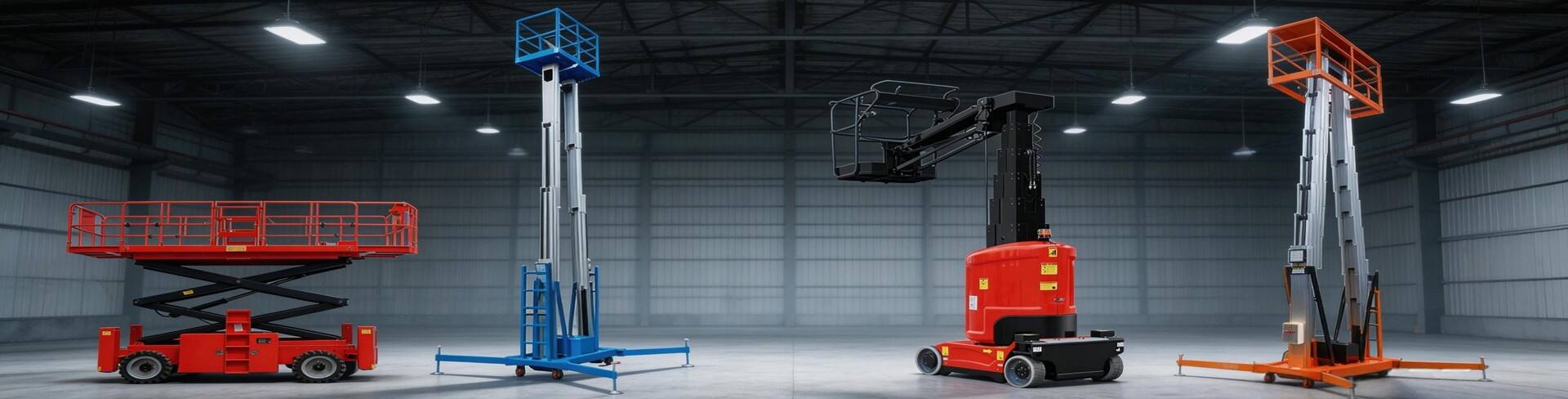
Telescopic Mast Lift: Core Definition & Mechanical Structure
In modern industrial and commercial facility maintenance, telescopic mast lifts have become indispensable precision equipment. Unlike traditional scissor lifts or boom lifts, this machine uses a set of nested aluminum or steel masts for vertical extension. Its primary design purpose is to provide safe and stable vertical access in extremely restricted spaces.
What Is a Telescopic Mast Lift?
A telescopic mast lift is an aerial work platform specially designed for narrow indoor environments. Its most distinctive feature is the "mast-type" arrangement of the lifting mechanism. The platform is smoothly raised to the target height through the telescopic sliding of multi-stage masts. These machines typically feature an extremely compact chassis and near-zero turning radius, allowing easy passage through standard doorways, access into passenger elevators, and flexible maneuvering among dense warehouse racking.
Core Component Breakdown
To fully understand telescopic mast lifts, an analysis of their precision working parts is essential:
· Mast System: As the core structure of the machine, high-end models are usually constructed from high-strength aluminum alloy to reduce weight and minimize sway during lifting. Masts are connected via precision sliders to ensure smooth, vibration-free movement.
· Power & Hydraulic System: The vast majority of telescopic mast lifts are powered by deep-cycle batteries, ensuring zero emissions and ultra-low noise for indoor operation. A hydraulic power unit drives mast extension, while electric drive motors handle chassis travel and steering.
· Chassis & Transmission: Equipped with non-marking solid rubber tires to prevent scuffing on expensive indoor epoxy or marble flooring. The chassis generally integrates automatic pothole protection, which deploys automatically when the platform is raised to prevent tipping on uneven ground.
· Platform & Controls: The control station is typically fitted with proportional joysticks, enabling operators to precisely adjust travel speed and lifting functions.
Main Classifications & Specification Features of Telescopic Mast Lifts
Driven by diverse operating scenarios, telescopic mast lifts have evolved into various product configurations to meet demands ranging from simple light replacement to complex industrial overhauls.
Self-Propelled Telescopic Mast Lift
This is the most widely used type on the market today.
· Function: Operators can control the machine’s ground movement via joystick, even when the platform is at full height.
· Advantages: Greatly improves operational efficiency by eliminating the need to lower the platform when repositioning. It is the preferred solution for high-frequency, multi-point maintenance tasks.
· Application: Indoor areas with flat, solid ground surfaces.
Push-Around Models
These telescopic mast lifts have no powered drive system and must be manually positioned.
· Features: Extremely simplified chassis structure, usually weighing half that of self-propelled units.
· Advantages: Ultra-lightweight design permits use on load-sensitive surfaces such as gym wooden floors or historic building stages.
· Limitations: The platform must be lowered and repositioned manually each time the work location changes.
Models with a Forward Jib
This type adds a short, rotatable and tiltable forward jib to the top of a conventional vertical mast.
· Features: Combines the vertical stability of a mast lift with the flexibility of a boom lift.
· Core Function: Delivers "reach-over" capability. For example, if the chassis is obstructed by ground obstacles, the forward jib can extend horizontally over the barrier to access the target work area.